

Déjà vu is a French term that literally means "already seen" and is reported to occur in 60-70% of people, most commonly between the ages of 15 and 25. The fact that déjà vu occurs so randomly and rapidly—and in individuals without a medical condition—makes it difficult to study, and why and how the phenomenon occurs is up to much speculation. Psychoanalysts may attribute it to wishful thinking; some psychiatrists cite mismatching in the brain causing us to mistake the present for the past. Still, parapsychologists may even believe it is related to a past-life experience. So what do we know for certain about what happens during an episode of déjà vu?

Some researchers speculate that déjà vu occurs when there is a mismatch in the brain during its constant attempt to create whole perceptions of our world with very limited input. Think about your memory: it only takes small bits of sensory information (a familiar smell, for instance) to bring forth a very detailed recollection. Déjà vu is suggested to be some sort of "mix-up" between sensory input and memory-recalling output. This vague theory, however, does not explain why the episode we experience is not necessarily from a true past event.
A different but related theory states that déjà vu is a fleeting malfunctioning between the long- and short-term circuits in the brain. Researchers postulate that the information we take in from our surroundings may "leak out" and incorrectly shortcut its way from short- to long-term memory, bypassing typical storage transfer mechanisms. When a new moment is experienced—which is currently in our short-term memory—it feels as though we're drawing upon some memory from our distant past.
A similar hypothesis suggests that déjà vu is an error in timing; while we perceive a moment, sensory information may simultaneously be re-routing its way to long-term storage, causing a delay and, perhaps, the unsettling feeling that we've experienced the moment before.
One characteristic is common of all déjà vu experiences: we are completely conscious that they are occurring, implying that participation of the entire brain is not necessary to produce the phenomenon.
Over the years, researchers have pinpointed disturbances of the medial temporal lobe as the culprit behind déjà vu. Studies of epileptic patients investigated via intracerebral electrodes demonstrate that stimulation of the rhinal cortex (such as the entorhinal and perirhinal cortices—structures involved in episodic memory and sensory processing) can actually induce a déjà vu episode.
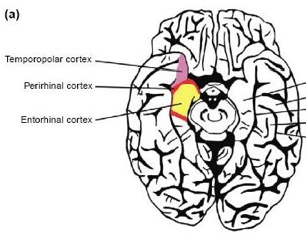 |
| Ventral (bottom) view of the brain, showing the perirhinal (red) and entorhinal (yellow) cortices. |
A study published in the current March issue of Clinical Neurophysiology analyzed the patterns of electroencephalography (EEG) signals from the rhinal cortices, hippocampus (involved in memory formation), and amygdala (involved in emotion) in epileptic patients for whom déjà vu could be induced by electrical stimulation.
The researchers (from France!—who better?) found that synchronized neural firing between the rhinal cortices and the hippocampus or amygdala were increased in stimulations that induced déjà vu. This suggests that some sort of coincident occurrence in medial temporal lobe structures may "trigger" activation of the recollection system.
While the cause and precise mechanism of déjà vu remains a mystery, worry not—if it happens, nothing is wrong with you. In fact, bask in the moment and appreciate the strange feeling that washes over you. Or pretend to be a fortune teller.
"It's like déjà vu all over again."
-Yogi Berra, on witnessing Mickey Mantle and Roger Maris repeatedly hit back-to-back home runs in the early 1960s Yankees' seasons.
Photos courtesy Michelle Winnie and UCL.
Bartolomei F, Barbeau EJ, Nguyen T, McGonigal A, Régis J, Chauvel P, & Wendling F (2012). Rhinal-hippocampal interactions during déjà vu. Clinical neurophysiology : official journal of the International Federation of Clinical Neurophysiology, 123 (3), 489-95 PMID: 21924679
I thought this was settled. Didn't you watch The Matrix?
ReplyDeleteI have had premonitions dejavu and lucid dreaming my entire 27 years. Lately however, they are happening frequently. I was at an AMC theater when I experienced what I thought was dejavu. A man was changing the butter telling a lady it would just be a minute while an elderly couple passed behind discussing a law pertaining to concessions. it wasnt until the following day that I recalled telling my husband about this dream. So I asked him casually if he remembered the dream about the butter and the law. He said yes. Maybe dejavu is a feeling we get because we have had dreams of these moments but cannot recall them. This would leave us feeling as though we had been there. We have...in our dreams. Maybe we all have premonitions.
DeleteTHAT'S WHAT I THOUGHT! IVE HAD A REOCCURRING DREAM TWICE, AND IT WAS ABOUT SURVIVAL, But, As I researched it up, I was told that I'm going through depression, or the need to survive, or that I'm going to loose my identity..
DeleteI have had several instances where I have experienced Deja Vu from a dream. It's not a dream I had years ago, more like a few weeks ago. I typically notice it more often when I am getting less sleep. Here's how it happens. I wake up without remembering my dream everyday when my alarm goes off. Between a month and a few weeks later whatever I dream about comes true. But it's really stupid stuff. The first time it happend I was taking out the trash. Or I'll be in a conversation and recognize it, and if someone says something, it's the same thing they said in my dream. I don't remember my dreams untill they happen. Also, in case you were wondering, this is how I know I dream in black and white. When comparing my dream to real life, I realize that the dream is lacking color.
DeleteNo I get it. I feel like what the definition of what deja vu is is not how I would describe it. I would say it's like a dream you have one day and then days or weeks later and it actually occurs in real life, as if you've predicted the future. However the definition says that deja vu is an image in your head that makes you feel like you've been there before when I feel like it's when you know it is going to happen sooner or later but definitely in the future.
Deleteexactly im 11 years old and when i was 3 i could tell what was going to happen right before it happened and when i was 5 right before the first day of kindergarden i had a dream it went wrong and it did the only dreams that i remember are regular dreams but right before something happens i have a feeling its going to happen
DeleteI think this is really interesting since I dream every single night this ''Deja vu'' and it happens A year later its strange.Also once during the art class my fellow student went to the blackboard to wright the test scores wenn I focused on him and kept on saying in my head for him to change F's into A's and he did it for a second but wenn I stoped he just rewrote it.
DeleteI am trying to understand why I have dreams from as far back as when I was in high school that are so vivid that when Deja vu happens it's the moment I dreamed about forever ago in complete detail happening years later. Or when I have an "episode" ( I am an epileptic patient) that I see objects or visions and then months or years later it finally happens in real life? When I am under a lot of stress I have visions that are very short and fast of objects, colors or surroundings that I haven't come in contact with yet and then later down the road I finally see it happening or that moment that I have already experienced in my "brain" like seeing the future. Usually it is a smell that is familiar but I can't put my finger on it that triggers my visions to happen in real time. A smell that I have smelled before or that I have come in contact with that takes me back or even forward. Can anyone explain why if the visions I am having haven't happen in my life yet, why can I see them in great detail months or years before they have even happened?
ReplyDeleteI often feel just like you, but with a twist. I have deja vu quite often, and I'm so very very sure that I experienced it before, just like you say - like it's a memory. There's no doubt in the moment. Unfortunately it's also almost always accompanied by a feeling of imminent doom - like I am remembering this now because it happened before - almost like I died and am reliving the same life, and remembering something right before I died. I'm so sure of my upcomming death that I immediately panic, but a minute later I remember that this happens to me quite often and I never die, and the fear goes away.
DeleteI only found this blog tonight because half an hour ago I was reading a comment thread on a tech blog. The comment set it off and of course I knew for sure when I read the next comment and it was also familiar, that I was going to die tonight unless I got out of this situation (I'm on an offshore platform at the moment which didn't help my anxiety in the least during that 'episode').
I suspect that if wasn't getting the same "death warning" every time that I would be as confused as you. I now attribute your situation and mine as the shortcut around short term memory (7 items or groups for 13 seconds) she was talking about in her post; the brain is putting new information in the "years ago" part of the long term (actually committed to) memory folder, and it feels like a confusing old memory. It happens all the time, but for the life of me I can never ever remember a time or place where I had the memory in the past. I just feel like I did; my brain really believes it did, with no evidence except that feeling.
Well mines kind of the same except I know for a fact I've had the dream when I was younger and I experience it almost exactly like you bc in the middle of doing something it will hit me and sometimes it last for awhile and sometimes I have multiple through out the day and sometimes I just stare at something and it randomly hits me. I know for a fact it was awhile ago when I had the dream i don't remember how long ago but I feel like it was as a child but for me I just realize I've been in the situation and from there on I attempt to remember what happened and even if I do remember the situation is so random that I can never tell what will happen and usually I realize the situation bc of a certain person and how they are either standing, how the look, or what they are doing. There is no possible way of explaining this feeling and just the thought of it I feel as though there is no way my brain is just storing this "new information" to the memory portion
DeleteI wasn't dreaming but I was in the state of, when suddenly, randomly some image of a guy appeared to me, saying my name, smiling at me, I saw a house, it was a backyard and kids were playing, what if that's a vision from the future that could happen in few years? Can you have a Deja vu when half awake, not only in dreams, and yes I was stressed and tired and it says that's when you have the chances to see something.
DeleteThe Deja's vu I had l pretty sure it was a dream the same it exact thing is happening right now in real life right now
Deletei usually see my deja vu moments in my sleep. i can vividly remember and even tell someone that this exact moment will happen. which anywhere from 2 weeks to a year the exact moment will occur. during the middle of the moment i realize that its deja vu but i still play along with the same answers to see if the result is the same. now that i am 18 years of age these memories or visions are becoming more frequent. its also usually an important mile stone or a great moment in my life. as of right now i feel like i could play out the rest of this year knowing possibly the most important events. its just mind boggling that i can remember this. although some slip my mind bc it is a dream after all and you forget after the first 5 mins being awake. it catches me off guard and i can still get that strange sensation that hits me like a brick wall. i feel as if we were able to unlock more than 10% of our brains then all of this would makes sense. we might actually be able to see into the future but because were running at such a low capacity there are only glimpses of it. looking to get feedback on this, good or bad.
ReplyDeleteI get the same exact thing. I'll have a deja vu moment when I'm awake.. but I'll be able to see a minute or two of what is about to happen. I see myself and what I am doing. If I do what I did in my deja vu, whatever I saw happens exactly. If I change what I said or did in my deja vu, it's all different. It's been happening for years to me and my mother. Very strange.
DeleteThis just happened to me 5 sec ago while a watched a YT video and i was freaking out
DeleteSeeing things.
ReplyDeleteIt happened to me today an I met someone important like a hour after the episode that change my life literally an about 2 weeks ago I had another episode and I met this chick about a hour after who is now my girlfriend
ReplyDeleteI'm a science buff and can't explain it
I'm also epileptic
Can someone help shed some light on it
I'm baffled an this is only 2 out of many times
It happened to me today an I met someone important like a hour after the episode that change my life literally an about 2 weeks ago I had another episode and I met this chick about a hour after who is now my girlfriend
ReplyDeleteI'm a science buff and can't explain it
I'm also epileptic
Can someone help shed some light on it
I'm baffled an this is only 2 out of many times
I have Had Deja vu Experiences numerous times. Almost always a dream I vividly remember playing out. Everything starts playing out the same way and I get a horrible feeling because the dream version had a bad ending. I think don't say this or please don't happen but it does. the only thing that doesn't happen is the bad ending. this startles me. Its always an unimportant scene. Just a random everyday event. I also have an experience that feels different to the one I just described this one is not dream derived. I just feel like the whole scene is familiar and that I've been there before.
ReplyDeleteOn the note of dreams. I have never died in a dream until a little while ago. It was a Friday morning when it happened. I woke up and felt uneasy all day. When I got home my mum said that something bad had happened. I expected her to say someone had died as soon as it reminded me about my weird dream. It turns out my dog had been put down that very day. Its like the dream symbolized my dogs death. My mother has also experience events like these. Such as dreaming all her teeth falling out shortly before discovering she has to get some teeth out and dreaming she was pregnant before we learn my sister is pregnant. we as witnesses remember her describing these dreams she had on the mornings she had them. My mums mum also had a sensation while she was on a bus with my grandad back in the day. she felt like something bad was going to happen to the bus and said to her husband we need to get off this bus is going to crash. they got off and the bus crashed later. people were injured and killed I think.
Is this all just coincidence? I think there may be things we don't understand that science cant explain.
call me crazy but this is what hapened : in a street lane me and my mates ware somking canabis and 2 drunk guys (trouble makers)and start asking us for change in that moment i think ive seen in the future that the fella doesn't pay he will get punched 10 second before the moment , the fella said no and just before he hits him i stop him and give him 2 euro then he calm down then went his way . u tell me if i changed the future or not :D
ReplyDeleteI believe that you were being tested and you passed. Everything happens for a reason ;-)
DeleteI get the same exact thing all the time. I'll have a deja vu moment when I'm awake.. but I'll be able to see a minute or two of what is about to happen next. I see myself and what I am doing. If I do what I did in my deja vu, whatever I saw happens exactly. If I change what I said or did in my deja vu, it's all different. It's been happening for years to me and my mother. Have no idea what it is..
DeleteI am 18 years old and since I was 4 I would dream the future or dream about people's past. I have an Aunt who lost a baby do to natural abortion, this happened when I was three but no one never told me this. This July I had a dream where I had a cousin from this Aunt but the cousin looked at me and died. So the next morning I called my Aunt and asked her about an unborn baby, she started crying, and told me the baby was 3 months old when she died. Dreaming about people's past has happened various of times; with friends, family, even people I see at the mall and randomly meet. Dreaming of my or other people's future has also being an every day torture for me.
ReplyDeleteactually i had experience of dejavu about 5 times once i was just sitting in my chemistry coaching classes suddenly one incident happened that some chemical reactions written on the board and it was lightening heavily and our chemistry teacher is shouting and saying that my voice is much more louder than lightening voice and everytime when dejavu occurs i just see my foot and i will feel like i have known about that thing previously or this thing happened previously also with me i dont know whether it is dejavu or something else and i even dont know when it is going to happen there is no time peroid fix for that anytime it can happen like i have experienced dejavu at the of 17 and after that at the age of 20,and again after 1 month the fourth experience was after 10day ,
ReplyDeleteand i have never felt like i have seen this in my dream it feels to me like it really happening or i know this thing that this is going to happen in the future...
ReplyDeleteI had this one experience the other day. Awhile back i had a dream, and in this dream I could hear someone say "Your voice sounds like it's rolling over waves". Of course this had little meaning to me at the time. About two weeks since, my friend was Skype calling me and when I raised the volume on my microphone, they told me that my voice sounded like it was "rolling over waves". I told them that I had heard them say this to me before and they argued that they had never said that phrase before in their life. I know I had heard it before. And now, I feel as though I'm remembering a lot of things before they actually happen. Like I'm stuck in a loop but I can't quite remember all of it.
ReplyDeleteMe too! I was wondering if I could find out why this strange thing happens to me. But no ones case seemed to describe mine. It really comforted me too know this happened or happens to someone else. So thank you very much.
DeleteHi, I've had a few but the most recent is I was at my mom's and I had a dream of all of these weird faces and pictures, and the one that stuck out most was a guy facing away from me without a shirt on with a bunch of flowers tattooed on his back, and some other stuff like demons and just weird stuff like a bunch of boxes and a ping pong table. Well anyway I had just got to Oklahoma, and was only there for about 3 months. I didn't know hardly anyone besides a couple of kids in the sub division and that was like three people. So one of the kids I knew said I'm going to my buddy Jonathans do you want to go, so I said yeah kool. We get there and it doesn't hit me until about 20 minutes of me sitting on the couch and then I finally realized I was remembering my dream, I saw ping pong table in his living room with all these boxes so I started looking around and I look to my right and see an entertainment center with glass doors with all these CD case covers taped to the inside like Godsmack, System of the Down and then I saw it it was a sublime CD case cover with a guy with no shirt on facing away from me with the word sublime tattooed on his back with flowers surrounding it the only thing I don't remember from the dream is the word sublime tattoo just the flowers and that was about 5 days before, and I never even met the guy let alone been in this house.
ReplyDeleteI've had dreams about the future, could be anything from a scenario in a game to real life events like being in a zoo and seeing the same things that i saw in my dreams or while im talking to people the same scenario and the exact same words are spoken and i recall it happening prior in a dream, and i always say deja vu when i realize what im doing/did is something iv'e seen in my dream/dreams weeks, or months before the event happening. But at rare occasions i get this "pre deja vu" feeling and know i dreamt about the things just about to occur and everything is leaning towards the same occurance i had in a dream, like if for example im talking about something, i remember this happening before in a dream, just sometimes for fun i switch to say somehting else or just do something else to make the "occurance" different. And still know that it would be the exact same thing i had in my dream had i not done the opposite.Or in a game everything seems to be happening just like in my dream(could be months before it actually happens), and i know that if for example will end up dead in the game(now im talking about a game called Heroes of Newerth, LoL and DotA type of a game) if i, say, run into a fight and i realize that midway that im about to have a deja vu and i know what is gonna happen so i immediantly use it as my advantage because i know what is about to happen, i end up killing them instead or just stay alive, whatever. But its not something i take lightly because i am aware that what i saw in my dream was something MEANT to happen, but i rewrite the destiny that was meant to happen by my own will... is that something good or bad? Been awhile since i had a deja vu(like up 1-2 years since i had my last), could it be because i myself changed the destiny of myself too many times and this is the result of it? or is it just me overthinking things?
ReplyDeleteoh and i am 20 and english isn't my main language fyi, feel free to write your thought about this, and if you have done the same as i have. Feel free to write about it im curious af.
DeleteMy experiences with precognitive dreaming are similar to yours. I've had 9 in the past three weeks so it finally dawned on me to start tracking them and looking into it. If anyone with experience with these (not psychic speculator wackos )that has good science, psychological, or religious data on why, or how these occur and the purpose if any of why it occurs I'd love to learn more.
DeleteSame with me. Don't worry about your destiny as deja vu happens in a short period of time and in random time (not relevant moments of life). but i don't think that u truly change things, u have tried to, then u realize that u have done the same. the moment u change something u will notice that the deja vu will turn into a vision of 6 - 10 sec in future (if i am not the only one). i had deja-vu even after changing thinks (deja vu moments r small and irrelevant for your future) so don't worry about messing with detiny
DeleteYesterday, I was thinking that may be one day FCB airplane would crash and every player would die. I had imagined how football world have been paying tribute to players who passed away... that was just in my thought... and today Cruyff passed away.. is it just a coincidence? How do you think? P.S. it's not the first time when I have such kind of thoughts and they come true almost in the same way.
ReplyDeleteHas anyone try to do something different from what is going on the deja vu during the deja vu. i have always try to do something different, but usually i had done the same, except for 1 time. in that occasion i stopped doing anything, after a few sec the deja vu turns into a vision. i knew EXACTLY (for a couple of minutes) what will happen, and what the other person involved in the deja vu (vision) will do or say, with a time gap of 6 - 10 sec before things happens, and i changed some thing, but the other person involved did and said EXACTLY the same thing of the vision. this episode had no relevance on my life, and is a stupid episode (couple of minutes of ordinary life), but was my first vision (had 3 in my life). my question is: has anyone try to do different from deja-vu and what happens to him/her (i share most of the description written here about the deja-vu with other guys, like i usually don't remember dreams and the fact that deja-vu happens in a time that is not relevant for the life)
ReplyDeleteHey i know what you are talking about. I want to know what is happening, because everytime I tell people about this kind of experience they don't understand. I will get deja vu and I will try to stop it because It scares me. Even if I try to stop it, it keeps on going just the way I knew it would.
DeleteSo I just experienced a deja vu type of moment. I was just walking around outside my home staring at my phone to find some stupid pokemon on pokemonGo. It was around 2 in the morning and I was walking outside. I knew I was going to get in trouble if I got caught, and then as I was walking back into my home I realized that I was remembering the exact dream I had of that moment as it happened. I knew exactly what was going to happen, which way I would look, even down to what was playing on the television and which lights were on. This game only came out recently and I downloaded it only two days before. I've never searched for pokemon at this early of an hour before.
ReplyDeleteAnd the thing is, whenever I lucidly dream, it's like whatever I think will happen, happens. Not what I want exactly, but what I sort of suspect will happen.
Just like when I have my deja vu moments. I don't will it to happen or anything, it's just that I guess what happens and whatever the guess is, good or bad, just happens. This has been going on since I was very young, I've always had these moments and dreams tie into eachother. I don't remember any of these dreams until I have the deja vu moments. I dont even think it's deja vu at this point, I think I'm having premonitions when I dream. And all of what I don't remember happens. I will only remember while the event takes place. Any dreams I do remember the next day does not happen. I probably sound crazy but I know what's happening to me. I just don't know what to call it.
I also have those feelings where I think it's like impending doom stuff, but what I've found out is that when I do start having these deja vu moments, it means I'm on track. I don't have these moments when I am distressed or upset. I have them when life is going good for me and I feel blessed. I feel like there's a higher spirit inside all of us that connects with us, and the people experiencing these moments like we do just have a stronger connection to that part within. We call it intuition but I think it's something greater than that. And I don't care if anyone thinks I'm batshit crazy or insane or whatever, so be it. Life's good.- cookingtoddlers
okay so just yesterday i had deja vu i was laying in bed at my hotel looking over my boyfriends shoulders at the curtains, i remember seeing this maybe a dream, but in that same instant i remembered a day back when i was in middle school in line for lunch, this had nothing to do with where i was or what i was doing but i remember that second while i was in middle school in line having deja vu as well. i don't know if this means anything but i thought it was very strange that i thought of both at the same time.
ReplyDeleteIt all started in year 2012. I had the most strange dream in my life. Some dogs were barking at me, next I saw people are digging ground at my grandmother's courtyard, my grandmother,s house was behind ours. I saw that people were actually making some arrangement for gathering as if someone recently died. Next morning I woke up and come out for office, while I was walking towards the bus stand suddenly a dog started barking at me.That reminded me of my last night,s dream. I kept walking suddenly saw a man who was carrying a long iron rode which looked very similar to the iron tool which people in my dream used for digging ground. That was enough to surprise me. I called my mother and told her about bad dream and she just told me not to worry as courtyard I had seen was not ours but that of grand mother's. Same day,s evening I got a call from my dad. On listening his voice I sensed something very bad happened. My uncle who was living in that house had an accident that day.
ReplyDeleteA day later he died. Many of my dreams come true next day. This is so frequent
I start feeling very used to. I have many instances. One morning my best friend phoned me and I told him why he was calling me. I told him that he got selected to a job. He was surprised how I could possibly know that, we were not even in the same city. I told him that I just had a dream on it. I have plenty of such dreams....
I have been having deja vu. But theres one thing that has happened to me a few times. I have remembered the exact moment I have done this act. I experienced this and noticed it at the moment I remembered. Anyone else?
ReplyDeleteIts not a glitch in my brain I have dreams I vividly remember and later sometimes days or weeks those things happen. i just cant make sense of it, why see thibgs before hand that seem insignificant.
ReplyDeleteI've had a lot of weird experiences with deja vu. Sometimes, I'll be talking with my friends and I get the feeling and say what they are about to say. The weirdest time was when I had a dream of going to a Trump event and finding a big knife. (I woke up before I saw the end of the dream)Then, a few months later, I went to a Trump event in my hometown and while I was standing in line I stepped on something hard. I assumed it was a rock, but when I picked it up it was a knife with a blade of at least 6 inches. (I ditched it in a hole and buried it so that security did not think I brought it, and just in case someone was going to try to come back for it and hurt people or something dreadful like that) Is it possible that some people get have visions or something?
ReplyDeleteMost of the time when i have a moment of deja vu, i predict a future that doesn't actually happen. A good example of this is when i was in class a few days ago. I was sitting in my dest doodling on a math page, my friend came up to me a complimented the dog i was drawing. For some reason my mind told me that this other kid that was standing very close to us would turn around and look, too, but he didn't.
ReplyDeleteI live with permanent deja vu. I guess in the end it all begins again and I am just remembering. If I get very stressed I am able to see into the future too.
ReplyDeleteIt happens to me sometimes often. I feel like I have experienced what I'm experiencing at that awkward moment. The feeling of being in existence or being born before my present moment. Everything that is said and done that moment is totally similar....like I'm being given a chance to redo or change something done before
ReplyDeleteAll I can say is that, Deja Vu is an experience which has been recollected from our repeated past lives which are repeated till we full fill the purpose of our life and also learn what has to be learned. I strongly believe that Deja Vu is a reminder to us that this life is again a repetition with all other people going through their repeated lives with different people for different purposes. Weird part is sometimes we cannot recall all of it at will. So either dig deep or just waste one more precious life living according to the dictated rules.
ReplyDeletehello i am just a dude in this world, i dont normally write on computers but i have had dreams that occur in the far away past, and they become reality in the future, one of the moments in a dream i cant remember the full detail but i had spilt a drink on my friend computer by accident, and then in reality it actually happened later perhaps a year and half later. i have had maybe 1 or 2 other moments but i cant remember them the computer one shocked me and i always remember it. for the future to be planned is such a drag, i pray its all just a coincidence. but its crazy how detailed the feeling and situation of the dream related to the reality and the distance of time between the two, i can barely remember a dream from yesterday. brothers and sisters i love you all ,good bye , what i have written here is just me getting something off my chest.
ReplyDelete