Navigate

Showing posts with label amygdala. Show all posts

August 29, 2013

Why do we cry when we're happy?

It's been awhile, braniacs. But I have an excuse! A good one, I swear!

I got married to the love of my life on August 10—who I, of course, met in a neuroscience lab a few years ago.

Something inexplicable has been plaguing me the past few months, though. Getting married, including the months of stressful planning and nightmares leading up to the big day, was the happiest time of my life.

I reveled in choosing dresses and shoes, booking vendors, and constructing centerpieces. I saw my family and friends a lot over the past few months. And, after all, I was celebrating one of the purest and most joyful things that can be celebrated in this crazy, mixed-up world: love.

But, for some reason, I found myself crying a lot more. Not out of sadness or frustration or hopelessness, though.

I mean, I couldn't even keep it together while walking down the aisle—something every girl, growing up, likes to daydream about...right? (See pathetic photo.)

Most of us have heard that crying, in essence, is good for us—that it relieves us when we're sad, releases stress and toxins, yadda yadda.

So what was with my sobbing on what was inarguably the happiest day of my life?

January 28, 2013

Smell and memory: Old feelings in a new place

My friend texted me something today that she thought I'd find interesting.

She had a meeting for work in an office she'd never entered before. Immediately as she entered the room, conflicting feelings of happiness and awkwardness washed over her.

The smell. It wasn't necessarily good or bad—just distinctive. And it didn't smell like anything in particular. All she knew was that it had an odor exactly like her boyfriend's dorm room when she was a freshman in college—something she hasn't experienced in five years—bringing back the paired feelings of excitement and nervousness that come with new relationships. And those of, well, being in a boy's stinky dorm room.

We've all experienced this at one time or another: a familiar perfume, a family recipe in the oven, the scent of a bonfire—they all bring back a flood of memories, momentarily whisking us away to re-live our past. But why does this happen?

October 30, 2012

Why are clowns scary?

A couple weekends ago, I came down with coulrophobia. Unfortunately, I have yet to shake the disease.

Because we are Halloween masochists, my friends and I drove out to the Lancaster area for Field of Screams, which can be best described as a horror-movie-set-haunted-house on steroids. Sprinting from room to room offers a completely new, dizzying experience, with different themes and scary people to touch you or chase you down with chainsaws.

But this one room. This one room was unlike any other...

It zigzagged. The walls were tiled with 2x2" black and white checkers. There was a strobe light. I was holding my friend's hand and trying to keep my eyes shut through the flickering.

Out of nowhere, sitting in the corner, tiny and dejected, was this freaking clown. It looked so far away. Then suddenly, not one second later, it was IN MY FACE. The strobe light betrayed my perception of its speed and distance. I cried out. Please, just take me now, and do it quickly...

Hence my newfound coulrophobia, or fear of clowns.

But is coulrophobia a real fear? And, for that matter, what is fear?

August 28, 2012

Catnip fever: Why your cat acts high

There are few things in this world more entertaining than cats. Except for, perhaps, cats on catnip.

Yes, "on" catnip. I speak of it like a drug, because it is.

Sure, make a laser pointer dance around the room and you've got endless hours of entertainment. But give Mittens a little toy mouse infused with catnip and—well, something changes.

Mittens will rub against the toy, rolling around and ecstatically chewing it. She may drool and become either sleepy or anxious. If you try to take the toy, she might act aggressive, scratching or biting at you.

Forget the mouse—Mittens wants the catnip inside. So what is catnip, and why is it causing your sweet kitty to behave so dichotomously?

January 6, 2012

The neuroscience of optimism: Why we resolve (and believe) we'll be better

If you're within the 32% of Americans that made a resolution for 2012, chances are you're still going strong. Nearly a week in, you've been faced with the temptation, the test of willpower, and likely some teasing from loved ones. And you've only got 360 days left to call your resolution a success? Easy as pie...

Experimentally (and in real life), our species has consistently demonstrated unbridled optimism in the face of adversity. We've failed for the past 20 years'-worth of New Years resolutions—but no, 2012 will definitely be the year we lose weight. Plus, we're all going to quit the jobs we despise and find a better-paying, less stressful, more rewarding job. AND win the lottery (brilliant—we'll never have to go back to work in the first place!).

A study by Tali Sharot and colleagues from New York University explored exactly why we can retain this buoyancy, thanks to insights in brain imaging.

October 3, 2011

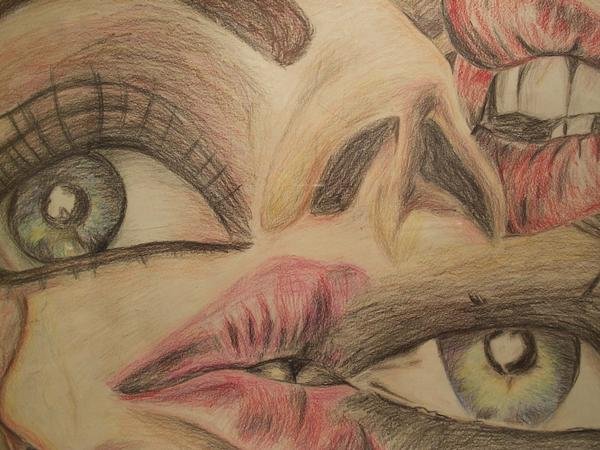
At face value: The amygdala recognizes the whole, not parts

Yesterday I was scanning through my iPhoto library when I came across some photos I had taken of my friends' eyes—just their eyes—from my freshman year of undergrad (it was finals week, and we were playing pool.

I can't claim the best study habits, but I got into grad school, alright?).

I turned to my boyfriend and had him identify whose eyes they were. To my surprise, he didn't get all of them correct, and he hesitated on most.

Aren't a person's eyes their most identifying feature?