Navigate

Showing posts with label perception. Show all posts

September 5, 2014

Why Does Hershey’s New Logo Look Like the Poo Emoji? Neuroscience Explains.

I live in the city of Hershey, the "Sweetest Place on Earth." I’m surrounded by references to chocolate everyday—from the smell of it in the air to Kiss-shaped streetlamps to chocolate-brown paved roads. It’s a pretty sweet life.

The Hershey Co.
WonderHowTo
So when The Hershey Company unveiled their new logo (above) last Thursday, I didn’t find anything unusual about it.

That is, of course, until the Internet began comparing it to the poo emoji, popularized by Apple.  Even after seeing the comparison, I still didn’t know what the big stink was about, so to speak.

Why did some people immediately see a big, steaming turd when, obviously, it’s supposed to be a drop of chocolate topped with the iconic Kiss flag? Actually, understanding the cognitive processes behind visual recognition can explain everything from Hershey Kiss poop emojis to why we perceive animals in clouds and Mother Mary’s face in a piece of toast.

August 6, 2014

3 Ways to Thrive at Work When Times Flies Faster Every Year

With our packed, non-stop schedules—career, family, chores, errands, and sleep (if we’re lucky)—everyone really wants to know one thing: How can we make our workdays fly by, and our time off stretch out luxuriously?

TED's partner site Return on Ideas asked me to write about the topic of my TED@NYC talk last month—why we perceive time flying faster as we get older—and give it a spin on our work life and career prospects.

You can read the piece here!

February 6, 2014

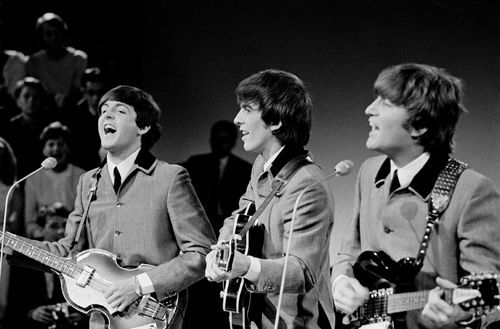
Love, Love Medulla: The Neuroscience of Beatlemania

The term “Beatlemania” has come to be associated with many things over the past half-century.

Coined in October 1963 during the Beatles’ tour of Scotland, the extent of Beatlemania in the United States is obvious by record sales alone. Between the 1964 release of “I Want to Hold Your Hand” on the Billboard Hot 100 and the Let it Be EP in 1970, the Lads from Liverpool had a Number One single for, on average, one out of every six weeks, and the top-selling album once every three weeks.

But to most, “Beatlemania” incites a vivid image of frenzied fans, predominantly teenage girls, looking as though they’ve just witnessed a gruesome murder. Fat buttons proclaiming “I LOVE GEORGE” adorn cardigan sweaters, hanging on for dear life as their owners attempt to push past overwhelmed human police barricades. Nurses stand at the ready, armed with smelling salts and ready to rouse the next fainting victim. Lots of tears. Lots of screaming.

As we approach the 50th anniversary of John, Paul, George, and Ringo’s first U.S. appearance on The Ed Sullivan Show this Sunday, we can’t help but look back and laugh nostalgically. Just what was it about the moptop haircuts, Cuban heels, and “yeah yeah yeah”s that turned us, our parents, or our grandparents into primeval beings whose sole purpose was to drown out the blare of a Vox AC30 amplifier?

As it turns out, neuroscience can (partially) explain the phenomenon.

December 18, 2013

Why Does Time Fly as We Get Older?

Originally posted at Scientific American MIND.

Another year; another Christmas around the corner.

The conversation around the watercooler these days has evolved into the annual “where has the time gone?” discussion—how quickly the neighborhood kids have become high school graduates; how our hot July beach vacations seem like they were just yesterday; and how we haven’t baked cookies or sent cards or bought gifts yet because time has just been flying by.

It’s become a common complaint—almost a joke—that time seems to whiz by faster and faster as we get older.

Of course, aging doesn’t grant us the power to disrupt the space-time continuum, so it’s not a real problem. But why do we perceive it to be?

December 12, 2013

'Twas the Neural Pathway of Christmas

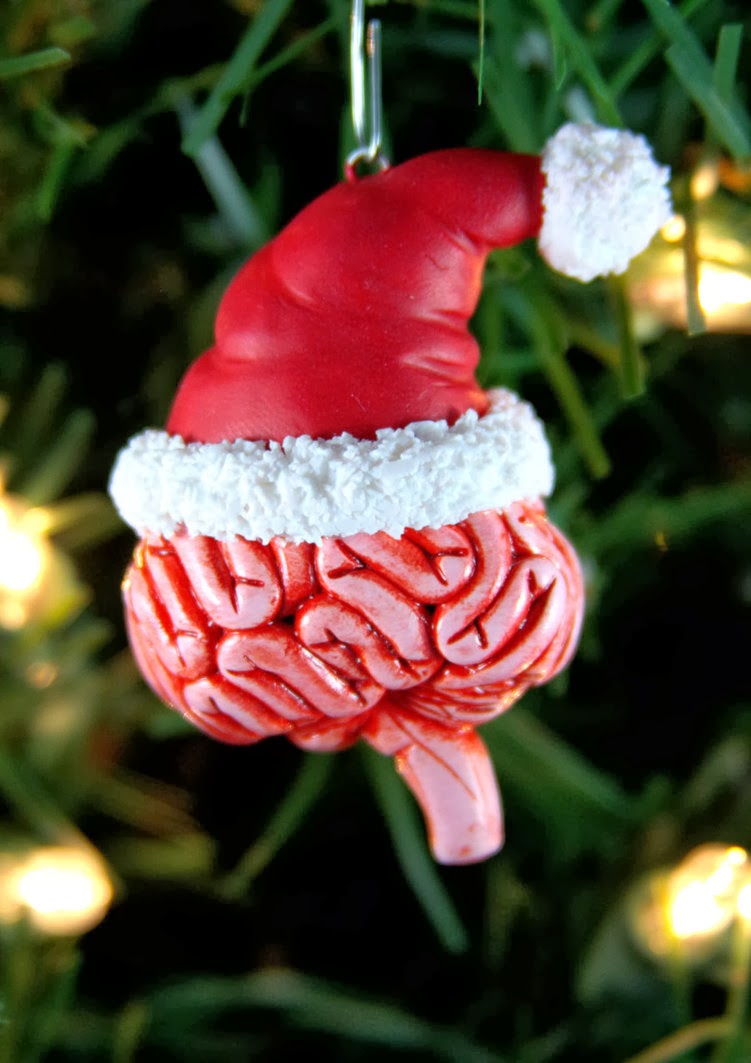
The following is an original and extraordinarily nerdy rendition of the classic Clement Clarke Moore poem adapted by yours truly, describing the basic pathway of happiness one feels when one sees a pleasant image—like Santa Claus!

Ornament by Neverland Jewelry.
'Twas the neural pathway of Christmas as my eyes do behold
A vision of St. Nicholas—red, so jolly, and bold.

His image burns into my retina, transmitting down optic nerve
Before the optic chiasm crosses in an unexpected swerve.

From optic tract to LGN—the sensory relay
Of six alternating layers; a complex neural highway.

Radiation to layer 4 of the visual cortex comes next—
But what follows leaves even the greatest minds perplexed.

For this vision becomes a signal, signal becomes a sense
Conversion of molecule to emotion—a feeling so intense.

Glutamatergic synapses fire onto the VTA—
A group of tiny neurons on the floor of the midbrain.

But wrong you are if you believe the brain to be tired,
For from VTA to nucleus accumbens dopamine is fired.

It is from this tiny region that glimpsing Santa brings such joy—
Pleasant emotional perception for every girl and boy.

So fleeting this emotion, as your auditory cortex hears,
 "A brainy Christmas to all—now, onward, reindeer!"

September 23, 2013

Prosopagnosia: Why Some are Blind to Faces

A few months ago, I had an hour-long conversation with Professor P in his office discussing his course that had just wrapped up. We veered off-topic toward the end of our talk, broaching the subjects of his grad school days, scuba diving hobby, and my blogging.

Less than an hour later, I was loitering around the college's entrance in my coat, ready to go home for the day. I spotted Dr. P locking up his office and gave him a wave.

He eyed me strangely and walked a couple steps closer before returning the greeting. "Oh, didn't recognize you in the coat. You were wearing green earlier. Have a good night, Jordan."

It would have been a puzzling encounter if I didn't already know about his strange afflication.

Dr. P has prosopagnosia, or the inability to recognize faces. "I only identified you by the blonde ponytail," he admitted, evidently blind to my appearance in his class everyday—much less from our extensive conversation just an hour prior.

August 2, 2013

One reason airline food is so bad? Your own tastebuds

Hey, readers!

I'm over at NBC News Health today discussing why we perceive airline food to be so bad, even when it really isn't.

(Spoiler alert: changes in air pressure and humidity affect our sense of taste and smell.)

Check it out here!

June 19, 2013

LEGO Faces are Getting Angrier; So What?

Transport yourselves back to sprawling across the living room floor—colored blocks scattered like confetti about the carpet—building the highest towers and fattest spaceships (without directions, of course), all the while ignoring your parents' yelps as they step on a rogue piece.

There's nothing quite like LEGO.

And certainly there's nothing quite like those ubiquitious yellow, blocky LEGO faces.

But a piece in The Daily Mail last week cites that "LEGO faces are getting angrier," and that this may, in turn, "be harming children's development."

Christopher Bartneck, of the University of Canterbury in New Zealand, will be presenting his findings at the First International Conference on Human-Agent Interaction in Japan this August. The central theme of the conference will explore how humans interact with objects that represent different personalities.

Whoa whoa whoa...let's slow down a bit. Perhaps LEGO faces have indeed become angrier—and more disdainful, more fearful, more smug—since their 1975 debut. But is it actually affecting the emotional and mental well-being and learning of a developing child?

June 5, 2013

Tone deafness and the brain

Hiya, brainiacs!

I've been having a crazy, exhausting, educational, and whirlwind week in Baltimore for the SLEEP2013 annual conference. Check out the Twitter hashtag #sleep2013 for real-time updates. Wednesday is the final day!

In the meantime, I'm over at NBC's The Body Odd blog today exploring a recent study on the neuroanatomical differences between amusics (tone-deaf individuals) and normal controls.

The authors found differences in short-term memory, electrical currents, and white-to-gray matter ratios in the two groups.

Check it out here!

June 2, 2013

Sound it out: Do you "see" or "hear" words you have to spell?

I have an extraordinarily intelligent friend. Halfway through veterinary school, she's a hard worker, an avid reader, and scores highly on standardized and academic exams. She excels at what she does, and I've met few other people in life with her brand of outstanding dedication and commitment.

But there is one feature about her that is so strangely unexpected—so strikingly opposite her accomplishments—to the point where it's just comical.

She can't spell to save her life.

Now don't get me wrong. The spellcheck has saved me more times than not, and while I'm no Arvind Mahankali (13-year-old New York native who just won Thursday night's 2013 Scripps National Spelling Bee; seen above competing in 2011), I never had too much difficulty remembering how to spell words that I'd read. What do we know about spelling, and why are some of our most brilliant peers some of the greatest misspellers out there?

May 16, 2013

Misophonia: enraged by everyday sounds

Very soon, I'll be joining forces with Scitable, a network developed by Nature Publishing Group.

(Don't worry—you won't miss any of my writing if you follow Gaines, on Brains!)

In preparation, I've got a piece on the Scitable Student Voices blog today about misophonia, or hatred of certain sounds.

Check it out here!

April 17, 2013

How stores trick our senses to make us buy more (Part 3 of 5: Touch)

(Read the previous posts in this series: taste and sight.)

There are few things more satisfying than running your hand over a rack full of cashmere sweaters, right?

My dad teases my mom and I when we're out shopping, asking why we must touch and comment on every garment's texture within arm's reach.

I mean, it just feels good. And many a Christmas has passed where my mom has received an especially fluffy sweater from yours truly, her partner in petting.

Sure, a company can do its job to create an attractive, pleasurable product for us consumers. But—you guessed it—the store does its own part in tricking us, ensuring that the phrase "you touch it, you buy it" often holds true.

April 10, 2013

Why do we sigh?

I sigh. A lot.

And, I realize, it's only when I feel discontent.

I sigh when I'm frustrated by statistics and can't make sense of the code on my computer screen. When I sit in class for three hours and daydream of all the productive things I could be doing. When I'm confused by the competing research literature on the desk in front of me. When I'm disgruntled by somebody's ignorant comments.

But why do I do it? Does it help regulate my breathing when I'm stressed? Is it a subconscious action I do to express to those around me that I'm anxious or upset? Perhaps a mental reset button, so to speak?

In fact, it may be a combination of all three.

April 2, 2013

Why we hate the sound of our own voice

Why don't we recognize our own voices when we hear a recording?

Most importantly, why don't we like what we hear?

I'm over at NBCNews.com's The Body Odd blog today explaining why.

Check it out here!

January 3, 2013

How stores trick our senses to make us buy more (Part 2 of 5: Sight)

The weekend before Christmas, I was sucked into a giant, enticing vortex of craving and desire, stuck for hours with the inability to leave—my only limitation being my wallet.

In other words, I went to Target.

And—again, in other words—I was like a bull in a China shop.

Back in 2009, Target introduced new gigantic, plastic, Playskool-esque shopping carts. Maneuvering the aisles is like passing a car on a one-lane country road in a Hummer.

Of course they're ridiculously cumbersome, but it's all a trick on the Target executives' part—the bigger your cart, the more you can fit in there. You'll look silly hauling around a couple packages of pens and a box of tissues to the checkout counter, after all. Better head to the appliance section and fill it with a microwave or plasma TV.

In this second installment, we'll explore how stores betray our sense of sight, tricking us to buy stuff we really don't want or need.

December 8, 2012

How stores trick our senses to make us buy more (Part 1 of 5: Taste)

On the first day of Christmas my true love gave to me...

...a bunch of crap I really didn't need.

With just sixteen shopping days until Christmas, it's easy to get roped into buying things we might not actually have on our gift list.

Most times, we're conscious of our impulse purchases—there's a great sale on this! I'll use that later!

But sometimes reasons for our frivolous purchases are not so obvious to us. Don't feel too bad—store chains actually hire researchers to study our shopping patterns and take advantage of our weaknesses.

Our brains are endlessly fascinatingly organs—but sometimes they betray us. The following is the first post in a five-part series on how stores trick our senses into shelling out more money than we may intend.

October 30, 2012

Why are clowns scary?

A couple weekends ago, I came down with coulrophobia. Unfortunately, I have yet to shake the disease.

Because we are Halloween masochists, my friends and I drove out to the Lancaster area for Field of Screams, which can be best described as a horror-movie-set-haunted-house on steroids. Sprinting from room to room offers a completely new, dizzying experience, with different themes and scary people to touch you or chase you down with chainsaws.

But this one room. This one room was unlike any other...

It zigzagged. The walls were tiled with 2x2" black and white checkers. There was a strobe light. I was holding my friend's hand and trying to keep my eyes shut through the flickering.

Out of nowhere, sitting in the corner, tiny and dejected, was this freaking clown. It looked so far away. Then suddenly, not one second later, it was IN MY FACE. The strobe light betrayed my perception of its speed and distance. I cried out. Please, just take me now, and do it quickly...

Hence my newfound coulrophobia, or fear of clowns.

But is coulrophobia a real fear? And, for that matter, what is fear?

September 16, 2012

Sight without seeing: Bálint's syndrome

Scientific literature is, to say the least, pretty dull.

It's rife with redundant phrases, confusing methodologies, and tiny graphs. Reading page after page of long words in small font is better than any over-the-counter sleep aid out there for getting the job done.

Occasionally, the rare gem will come along just when you least expect it, providing a readable (dare I say—enjoyable) account of the latest research.

So begins a paper published this past week in Neurology:

"It was a quiet Thursday afternoon when 'A.S.', a 68-year-old woman from a suburb of Chicago, awakened from a nap to the realization that something was terribly wrong."

What?! What's wrong! Must...keep...reading...

As the article continues, we learn how A.S. and another patient, J.D., adjust to their lives before and after their diagnoses of Bálint's syndrome.

April 6, 2012

Clothes make the man—literally

In the sleep research lab where I'm currently completing my rotation, we are bringing back students for a follow-up study. Most of them don't seem to recall the uncomfortable beds or having electrodes pasted to their scalp from their baseline test, which was done back when they were in elementary school. (For our sake in recruiting participants, that's probably for the best.)

Nowadays they're older, wiser, more self-aware, and, as teenagers, a bit more judgmental. The researchers in charge of performing psychometric testing—new college grads and not much older or taller than the participants themselves—recently made an interesting observation: if they wear a white coat when interacting with the participants (and their parents), they receive more respect.

According to a study by Hajo Adam and Adam Galinsky of Norwestern University, it's possible that our psych testers not only look more professional, but subconsciously feel more professional. In other words, the clothes may literally make the man (or woman).

The study, published February in the Journal of Experimental Social Psychology, observed an interesting phenomenon: wear a white coat you believe belongs to a doctor, and you'll be more focused. Wear a white coat you believe belongs to a painter, and you won't see that improvement.

March 4, 2012

Using psychology to silence your enemies: the speech-jammer gun

Chances are you've been in a quiet, peaceful place, such as a library or work cubicle, concentrating intently on a task at hand, when suddenly someone's obnoxious ringtone goes off. That's bad enough. But then they answer it, and you're subjected to five or ten minutes of one-sided conversation, giggles, and abject, torturous curiosity. Don't you just want to shoot that person? Well, now you can.

And you won't even go to jail for it—for this new silencing gun, or "speech-jammer," uses not ammunition to do the trick, but psychology!