Navigate

Showing posts with label children. Show all posts

November 28, 2014

Exposure to Different Forms of Violence Affects Kids’ Sleep Differently

I have a guest post today with the British Psychological Society's Research Digest blog. The piece is based on a new study in the journal Sleep Medicine showing that children exposed to different forms of violence in their community are plagued with different types of disturbed sleep.
Two particular types of violence stood out to researchers in terms of their association with sleep disturbance. Controlling for relevant confounders (such as age, gender and family income), individuals who were physically assaulted had a shortened sleep duration (by 35 minutes on average), exhibited almost three times as much wake time after sleep onset, and 6 per cent lower sleep efficiency than kids who did not experience physical assault. These effects were also seen three months later at follow-up. 
On the other hand, children who witnessed a homicide had twice as much wake time after sleep onset, greater night-to-night variability in sleep duration, and more self-reported sleep problems than kids who had not witnessed a homicide. These findings, however, did not persist at follow-up.
Read more of the post here!

April 11, 2014

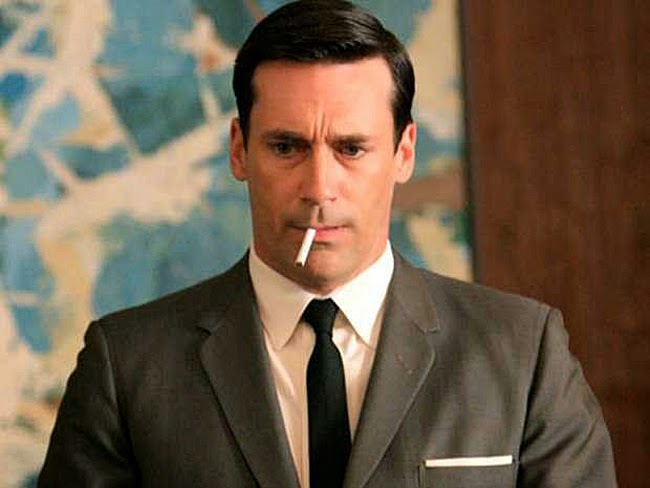
A Mad Man, Indeed: Don Draper on the Couch

AMC
When last we saw our fearless antihero, Don Draper, he was standing face-to-face with his crumbling, dilapidated childhood home. Surprisingly, his three children were by his side as he took these first tentative steps towards admitting his past life. In the episode's final moments, he shared a knowing glance with his oldest (and somewhat estranged) daughter, Sally.

In Season 7 of Mad Men, which launches this Sunday on AMC, we hope for some closure on the real Don Draper and the secret life he created for himself.

Draper was named #1 Most Influential Man by online magazine Ask Men in 2009 (ahead of real people, mind you), and Comcast has christened him one of TV's Most Intriguing Characters.

And rightfully so. Draper is the perfect character study for Drama 101, introduced to us in 1960 as the dapper, charming creative director for the fictional NYC advertising firm Sterling Cooper.

But as the series unfolds, it’s hard to ignore Don’s cynicism, arrogance, and womanizing tendencies. He drinks and smokes too much. He’s cheated on both of his wives (many, many times). He's left his children home alone (to deal with an intruder, no less), and Sally once caught him having sex with a neighbor. And let's not forget that he was basically fired in the last episode.

But perhaps most telling is that Don Draper's name is actually Dick Whitman, a Korean war deserter who switched Lt. Donald H. Draper’s dog tags with his own and created a new life for himself.

We love him. We hate him. And we definitely don’t understand him. Many questions remain, but perhaps the most puzzling of all is simply: who is Don Draper, and why is he the way he is?

June 19, 2013

LEGO Faces are Getting Angrier; So What?

Transport yourselves back to sprawling across the living room floor—colored blocks scattered like confetti about the carpet—building the highest towers and fattest spaceships (without directions, of course), all the while ignoring your parents' yelps as they step on a rogue piece.

There's nothing quite like LEGO.

And certainly there's nothing quite like those ubiquitious yellow, blocky LEGO faces.

But a piece in The Daily Mail last week cites that "LEGO faces are getting angrier," and that this may, in turn, "be harming children's development."

Christopher Bartneck, of the University of Canterbury in New Zealand, will be presenting his findings at the First International Conference on Human-Agent Interaction in Japan this August. The central theme of the conference will explore how humans interact with objects that represent different personalities.

Whoa whoa whoa...let's slow down a bit. Perhaps LEGO faces have indeed become angrier—and more disdainful, more fearful, more smug—since their 1975 debut. But is it actually affecting the emotional and mental well-being and learning of a developing child?

October 19, 2012

Kids' willpower influenced by others' reliability

Think back to your childhood Halloween: 9pm, a school night, pillowcase full of candy.

Just as you plunge into your pile of peanut butter cups, fun size this-and-thats, and spider rings (weren't they so exciting?), Mom ruins the party. "You can eat three. Then go brush your teeth and get ready for bed."

Did you eat just three? Or did you sneak an extra Baby Ruth or two when she wasn't looking?

A study published earlier this month in Cognition suggests that willpower is not the only factor in play when it comes to foregoing that extra piece.

Instead, a child's belief about their superiors' reliability can change their willingness to wait for a better payoff later.